What is Vinyasa Yoga? Consciousness in Motion
Karen Hamilton | SEP 21, 2021
vinyasa yoga
yoga flow
What is Vinyasa Yoga? Consciousness in Motion
Karen Hamilton | SEP 21, 2021
~ Shiva Rea
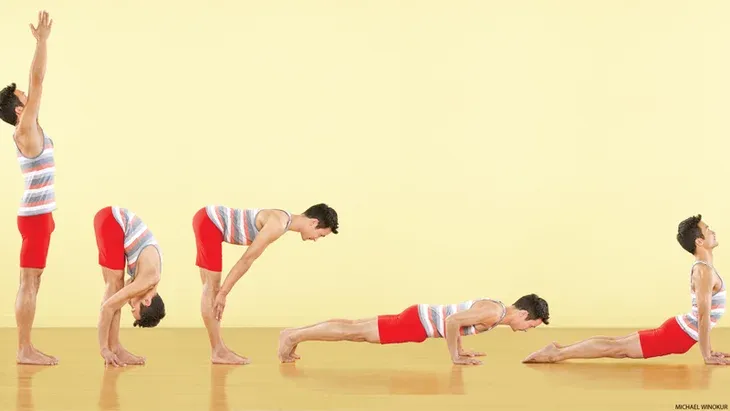
Sit back and relax. Take in these images and see if you can sense the underlying pattern: the flow of the seasons, the rise and fall of the tides in response to the moon, the flow of Surya Namaskar (Sun Salutation).
What do these diverse phenomena have in common? They are all vinyasas, progressive sequences that unfold with an inherent harmony and intelligence. “Vinyasa” is derived from the Sanskrit term nyasa, which means “to place,” and the prefix vi, “in a special way” In the yoga world the most common understanding of vinyasa is as a flowing sequence of specific asanas coordinated with the movements of the breath.
The great South Indian master Krishnamacharya, championed the vinyasa approach as central to the transformative process of yoga. But Krishnamacharya had a broader vision of the meaning of vinyasa than most Western students realize. He not only taught specific asana Yoga movement) sequences, but he also saw vinyasa as a method that could be applied to all the aspects of yoga. In Krishnamacharya’s teachings, the vinyasa method included assessing the needs of the individual student (or group) and then building a complementary, step-by-step practice to meet those needs. Beyond this, Krishnamacharya also emphasized vinyasa as an artful approach to living, a way of applying the skill and awareness of yoga to all the rhythms and sequences of life, including self-care, relationships, work, and personal evolution.
Vinyasa yoga requires that we cultivate an awareness that links each action to the next—one breath at a time.
Applying vinyasa in your yoga practice and daily life has many parallels. moving through life demands a synchronization with natural forces that requires skill and intuition, the ability to set a course yet change with the wind and currents.
The teachings of yoga include a view that constant change is an inherent part of life. Therefore, to proceed skillfully with any action, we must first assess where we are starting from today; we cannot assume we are quite the same person we were yesterday. We are all prone to ignoring the changing conditions of our body-mind; we often distort the reality of who we are based on who we think that we should be. This can show up on the yoga mat in any number of inappropriate choices: engaging in a heating, rigorous practice when we’re agitated or fatigued; doing a restorative practice when we’re stagnant; going to an advanced yoga class when a beginning class better suits our experience and skills. In order to avoid such unbeneficial actions, we need to start out with an accurate assessment of our current state.
In teaching my students about vinyasa, I offer them ways of checking in with their current state at the start of their session. I also will suggest specific strategies for addressing impediments that may break up the flow of their practice. For example, on the bodily level students can choose a more calming practice or one that provides them with a more invigorating opening. If they have a twinge in the lower back, they might want to modify certain postures, perhaps substituting Cobra Pose for Upward-Facing Dog Pose. If they’re suffering from typical urban tensions in the neck and shoulders, they can use a small series of stretches—a mini-vinyasa, you might say—to encourage softening and release. On a more internal level, agitated students can focus on releasing tension by relaxing the face and breath; if their energy is more lethargic and diffused, they can focus on their drishti, or gaze, to increase their concentration.
The same insight that we use on the yoga mat can be applied to the way that we initiate actions elsewhere in our lives. Are you feeling anxious on your way to a big appointment? Drive more slowly and listen to some calming music to ensure that this imbalance doesn’t carry over into your meeting. Such adjustments do not show an unwillingness to accept what is or a compulsive attempt to fix everything until it is just right. Rather, they are evidence of a deep awareness of and appropriate response to reality. A yogic sailor embraces the changing winds and current and the challenge of setting course in harmony with the ebb and flow of nature.
Once you’ve properly assessed conditions and initiated action, you can focus on the next phase of vinyasa: building up your power, your capacity for a given action. Power is the sailor’s ability to tack with the wind, a musician’s ability to sustain the rise and fall of a melody, a yogi’s deepening capability for absorption in meditation.
The vinyasa method has many teachings to offer about how to build and sustain our capacity for action, both on and off the mat. One of the primary teachings is to align and initiate action from our breath—our life force—as a way of opening to the natural flow and power of prana, the energy that sustains us all on a cellular level. Thus in a vinyasa yoga practice, expansive actions are initiated with the inhalation, contractive actions with the exhalation.
Take a few minutes to explore how this feels: As you inhale, lift your arms up over your head (expansion); as you exhale, lower your arms (contraction). Now try this: Start lifting your arms as you exhale, and inhale as you lower your arms. Chances are that the first method felt intuitively right and natural, while the second felt counterintuitive and subtly “off.”
This intuitive feeling of being “off” is an inborn signal that helps us learn how to sustain an action by harmonizing with the flow of nature. Just as a sagging sail tells a sailor to tack and realign with the energy of the wind, a drop in our mental or physical energy within an action is a sign we need to realign our course. In an asana, when the muscular effort of a pose is creating tension, it’s often a signal that we are not relying on the support of our breath.
When we learn how to sustain the power and momentum of the breath,
the result is like the feeling of sailing in the wind—effortless effort.
To build real change in a student’s capacity for action, Krishnamacharya utilized a method which he entitled vinyasa krama (“krama” means “stages”). This step-by-step process involves the knowledge of how one builds, in gradual stages. Vinyasa krama is also the art of knowing when you have integrated the work of a certain stage of practice and are ready to move on. I frequently see students ignore the importance of this step-by-step integration. On the one hand, some students will tend to jump ahead to more challenging poses like Forearm Balance before developing the necessary strength and flexibility in less-demanding postures like Downward-Facing Dog, Headstand, Handstand, and other, easier arm balances. The result: They struggle to hold themselves up, becoming frustrated and possibly injured. These Type-A students should remember that strain is always a sign that integration of the previous krama has not yet occurred.
On the other hand, some students may congeal around the comfort of a beginning stage and become stagnant; they often become totally energized when given encouragement to open to a new stage which they had written off as beyond their abilities.
All of us are better at some part of the vinyasa cycle than others. I love to initiate action and catalyze change but have to consciously cultivate the completion phase. As Desikachar explains it, “It is not enough to climb a tree; we must be able to get down too. In asana practice and elsewhere in life, this often requires that we know how to follow and balance one action with another.
In vinyasa, how we complete an action and then make the transition into the next is very important in determining whether we will receive the action’s entire benefit. These days I invite my students to complete classes by invoking the quality of yoga into the very next movements of their lives—how they walk, drive, and speak to people once they leave the studio.
It is important to remember a vinyasa is not just any sequence of actions: It is one that awakens and sustains consciousness. In this way vinyasa connects with the meditative practice of nyasa within the Tantric Yoga traditions. In nyasa practice, which is designed to awaken our inherent divine energy, practitioners bring awareness to different parts of the body and then, through mantra and visualization, awaken the inner pathways for shakti (divine force) to flow through the entire field of their being. As we bring the techniques of vinyasa to bear throughout our lives, we open similar pathways of transformation, inner and outer-step by step and breath by breath.
Karen Hamilton | SEP 21, 2021
Share this blog post
 OfferingTree